
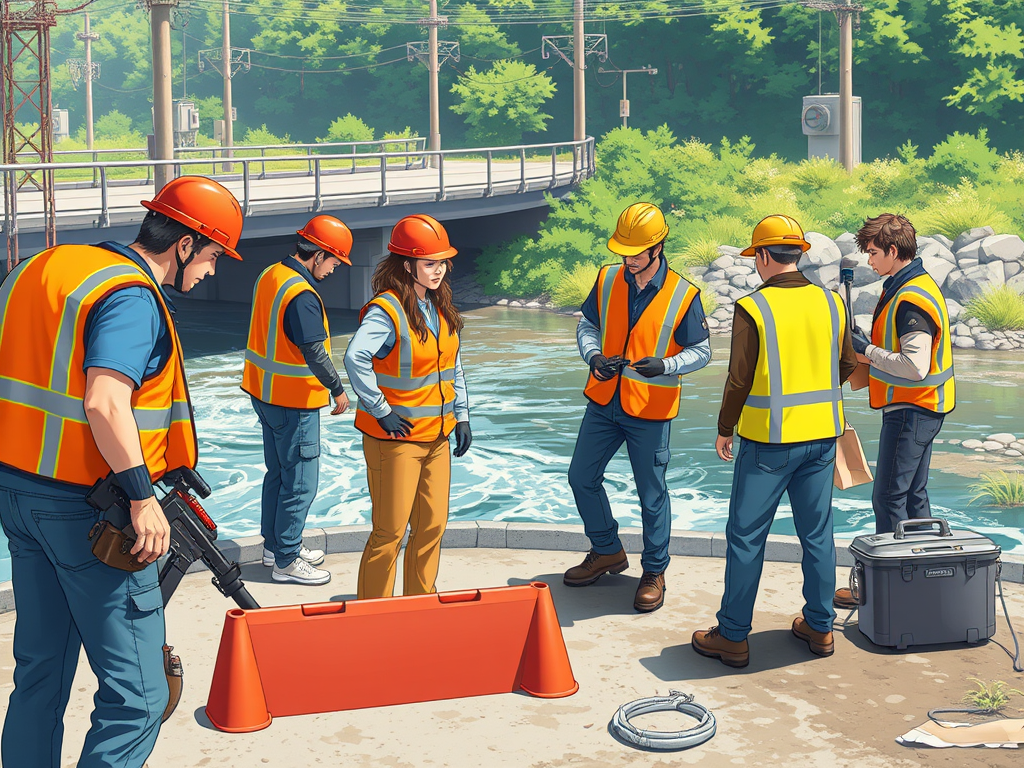
Unified Government staff gathered last week. They participated in a flood-fighting exercise. The exercise was designed to strengthen response efforts along the Turkey Creek Flood Protection System in Kansas City, Kansas.
The Unified Government reported that the training was hosted by Environmental Services Stormwater Engineer Sarah White. It brought together staff from Environmental Services, Street Maintenance, and Emergency Management. The exercise gave crews a chance to practice tactics ahead of the spring and summer storm seasons.
The day began at the Environmental Services Campus with a tabletop exercise. During this activity, teams reviewed mock flood scenarios. They also discussed possible responses. Crews then moved to the Mill Street Bridge near Southwest Boulevard for a hands-on field exercise. There, they inspected the flood protection equipment. They tested it as well. Finally, they reviewed its effectiveness. The training continued at the Turkey Creek Tunnel, a century-old structure that still plays a key role in flood management.
The tunnel was built between 1918 and 1920. It was originally cut through the Greystone Heights bluff. This was done to reroute Turkey Creek more directly into the Kansas River. Modern upgrades have enhanced the system’s capacity. It can now handle 18,000 to 20,000 cubic feet of water per second. This is about the same daily flow as the Missouri River. This capacity allows it to divert floodwaters beneath downtown streets, railroads, and businesses, protecting both property and infrastructure.
“This exercise was an important opportunity to put our plans into action and make sure that our teams are prepared for whatever the season brings,” White said. “Regular training like this helps us stay sharp and ready to respond when it matters most.”
The history of Turkey Creek includes devastating floods in 1844, 1951, and 1993. These floods caused widespread damage to homes, businesses, and critical infrastructure. Those events led to major investments in flood control systems still in use today. These systems include the tunnel under Interstate 35 and expanded flood channels.
“Proactive planning makes all the difference when responding to severe weather events,” said Matt May, UG Emergency Management Director. “By working together now, we can react faster, communicate better, and ultimately protect more people and property during a flood.”
After the field exercise, participants returned to the Environmental Services Campus. They held an after-action review to discuss lessons learned. They also considered ways to further improve flood response procedures.


